D82|LABS
Subscribe Engage

D82LABS / PRODUCTS / INVOICEDAY

Loved baking. Priced on a guess.

InvoiceDay is a kitchen costing and pricing workbook for home bakers and cottage-food sellers. It turns what you actually pay for ingredients, packaging, and your own hours into a defensible price per batch — then subtracts the channel's cut, Etsy fees included, before you post the listing. If the margin isn't there, the sheet says so in plain words: RAISE, TIGHT, or OK.

Status
Live · v1 · 2026-09-26
Format
Excel 2021+/365 · Google Sheets · no macros
Built for
Home bakeries & cottage-food sellers

One-time · 30-day refund, no interrogation · one purchase = one business

The Problem

The leak isn't the flour. It's everything the flour price leaves out.

Ask a home baker what a batch costs and you get the ingredient receipt. The real cost also includes packaging, labels, the hour and a half of mixing and decorating, and the slice the sales channel takes before the money reaches you. Omit any of them and every "sold out" weekend is quietly working for free.

The three leaks

  • Ingredient-only pricing. Vanilla doubled, butter jumped, and the menu price is still last year's guess. Costs move; guesses don't.
  • The forgotten costs. The box, the liner, the sticker, the parchment. Fifty cents a unit doesn't sound like anything until you multiply it by everything you sell in December.
  • Fees after the sale. Marketplace and payment fees come off the top. A price that "feels right" can clear 40% less than you think after the channel is paid.

Why existing calculators don't fix it

  • Most free calculators stop at ingredients. Time and fees — the two numbers that decide whether a bake is worth selling — are left to vibes.
  • Static templates don't grade the result. You still have to know whether your price is right, which is the thing you bought the calculator to learn.
  • Generic business spreadsheets assume a business. InvoiceDay assumes a kitchen: recipes, batches, yields, per-unit thinking.

The Product

Seven sheets. One habit: price before you post.

The Classic Chocolate Chip Cookies example is preloaded in every sheet — you can watch a batch cost itself, get a suggested price, and see an underpriced order turn red before you enter a single ingredient of your own.

What's inside

  • START HERE — the five-step workflow in plain language.
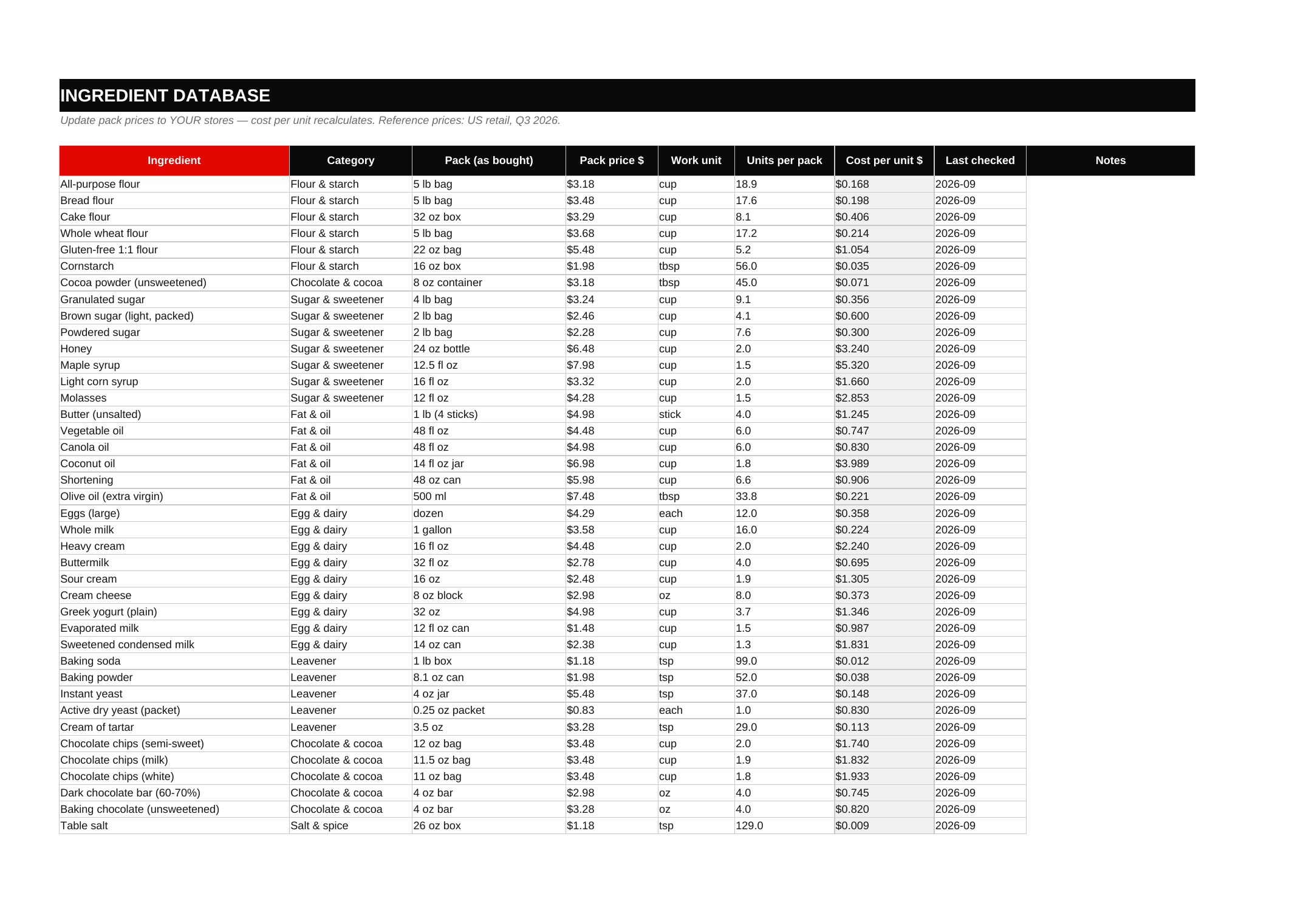
  • INGREDIENTS — 72 baking staples with reference pack prices and automatic unit costs (cup / stick / tsp / each). Update to your receipts; add your own.
  • RECIPES — one summary row per recipe; ingredient lines with dropdowns. True batch cost and cost per unit compute themselves.
  • PRICING — packaging, labor hours, hourly rate, channel, and target margin in; a fee-aware suggested price out, rounded to $0.25.
  • ORDERS — one row per sale; fees, net revenue, COGS, and profit per order, automatically.
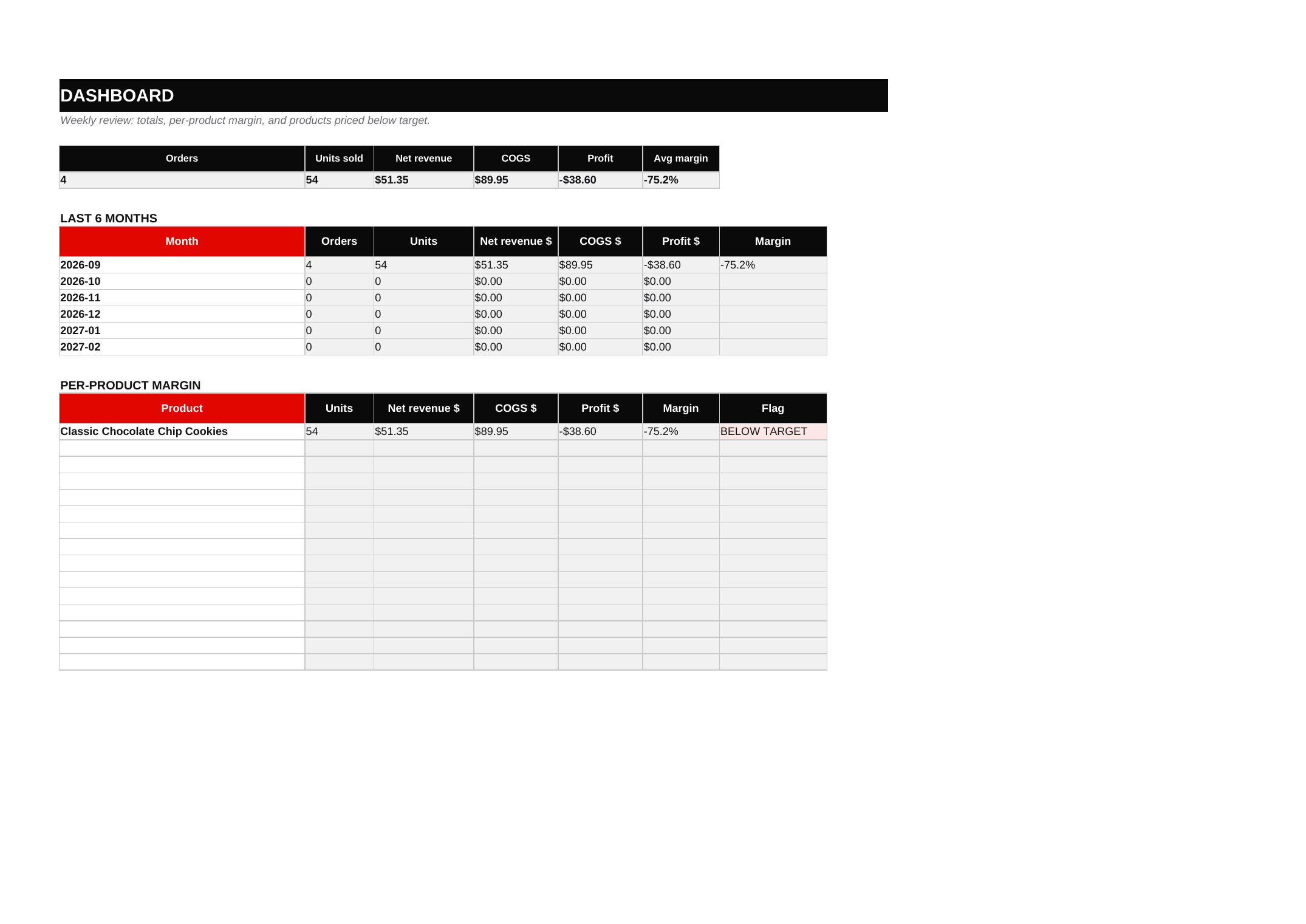
  • DASHBOARD — monthly totals and per-product margin, with products below target flagged.
  • SETTINGS — channel fee presets (Etsy, PayPal, Stripe, Square, cash) you can edit, plus your defaults.

The margin signal

  • OK — your price clears your target margin after fees. Post it.
  • TIGHT — within five points of target. One bad ingredient month erases it. Consider rounding up.
  • RAISE — below target. The demo order log is deliberately loss-making so you can see the flag catch it.

Target margin and hourly rate are yours: they live on SETTINGS, not in our formulas.
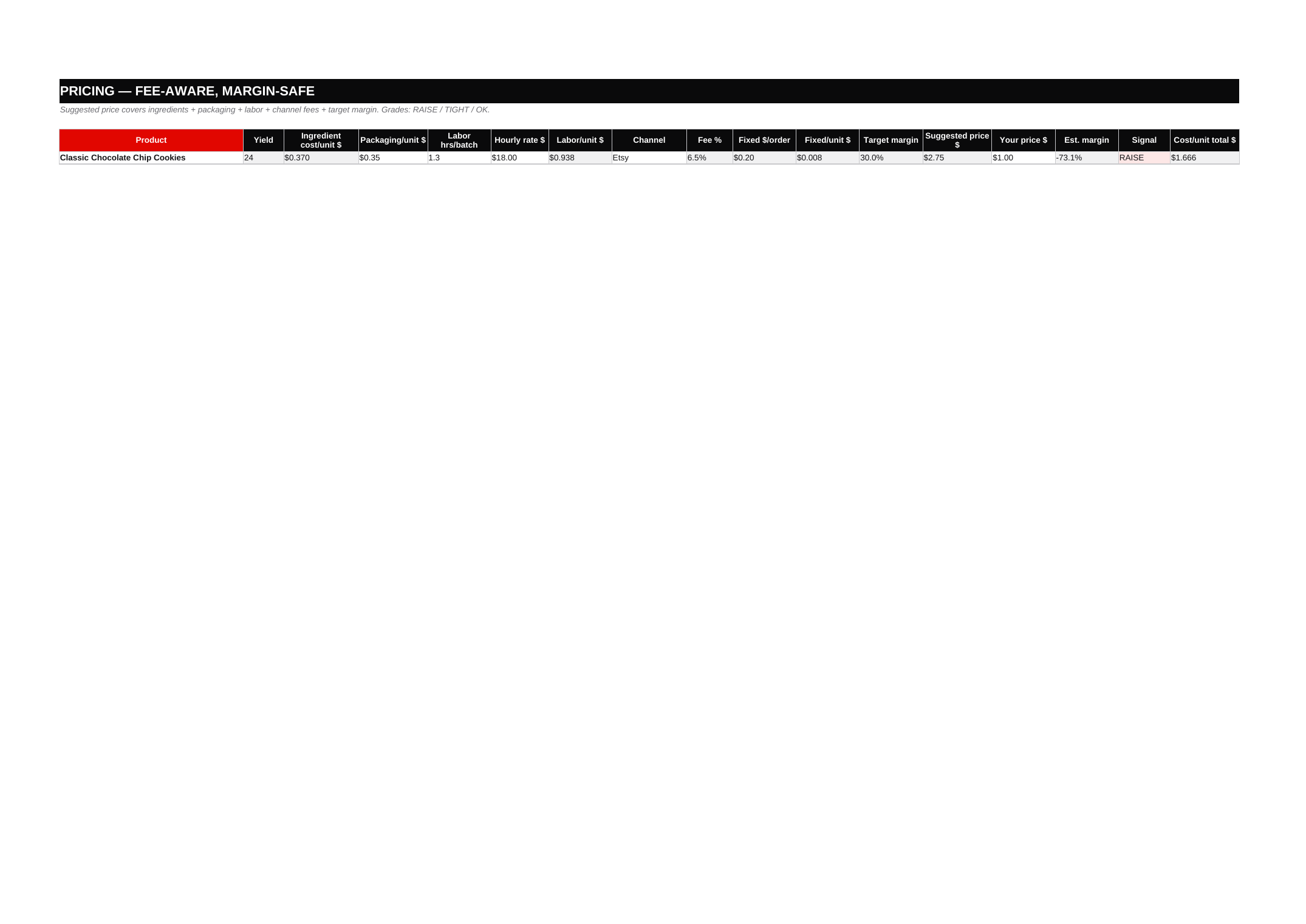
InvoiceDay pricing sheet: cookie recipe with ingredient cost per unit, packaging, labor, Etsy fee preset, target margin, suggested price $2.75 and a RAISE signal on the entered price
PRICING. The demo cookie costs $1.67 all-in; the sheet suggests $2.75 to hold a 30% margin after Etsy's cut. The $1.00 entry gets flagged RAISE.
InvoiceDay ingredient database with categories, pack prices, work units and computed unit costs for 72 baking staples
INGREDIENTS — 72 staples with reference prices. Your receipts replace ours in minutes.
InvoiceDay dashboard with KPI cards, monthly totals and per-product margin flag
DASHBOARD — monthly totals, per-product margin, and a flag on anything priced below target.

Honest Comparison

Why not just ask a general AI, or grab a free template?

A general AI chat can explain food costing. It cannot hand you a working system: a 72-ingredient unit-cost database with real conversions (how many teaspoons in a box of baking soda), dropdown-linked recipes, fee presets that match actual Etsy/PayPal/Stripe terms, and margin signals that recompute every time butter goes up. Free calculators usually stop at ingredients; paid templates rarely grade the price you enter. InvoiceDay's structure, conversions, and signal logic are original D82Labs work. The file is the artifact; the judgment stays yours.

Free Seasonal Sample

Shipping holiday preorders? Plan the season free.

The InvoiceDay Holiday Order Planner is a free Excel/Google Sheets workbook for cottage-food bakers running October–December preorder volume: an order log with deposits and balances, a production schedule that turns open orders into bake-day batches, a delivery run sheet, and a one-glance dashboard. It plans volume, dates, and money owed — it deliberately does not do invoicing or fee math. That boundary is what makes it an honest sample: if it saves your Thanksgiving week, the full InvoiceDay above turns each delivered order into a priced, fee-checked invoice.

Get the free Holiday Order Planner Free · no email-gated tricks · the paid upgrade is InvoiceDay itself

FAQ

Asked before purchase.

Compatibility

  • Excel: 2021 and Microsoft 365, Windows and Mac. No macros, no add-ins, no external links.
  • Google Sheets: File → Import → Replace spreadsheet. All formulas are Sheets-compatible; recreate the dropdowns if they drop on import (START HERE explains how).
  • Excel 2019: should work, untested by D82Labs.

About the reference prices

  • The 72 pack prices are US national-average retail reference points (Q3 2026), included so the sheet works the moment you open it. They are not quotes — replace them with your receipts before making pricing decisions.
  • Conversions use standard US baking equivalents (1 cup AP flour ≈ 4.25 oz; 1 stick butter = ½ cup). Ingredient-level equivalents are listed per item.

Buying

  • $24 one-time. Delivered via Gumroad as a single .xlsx — one excellent artifact, no filler bundle.
  • 30-day refund, no interrogation: crabrat@d82labs.com.
  • License: one purchase = one business. Don't redistribute the file.
  • Defect reports are fixed in the next patch release, free to existing buyers.

Limits, stated

  • It will not file cottage-food paperwork, track inventory, or do your taxes. It prices your batches and grades your margins.
  • Labor hours per batch are your estimate to keep honest. The sheet makes the cost visible; it cannot make you charge it.

Evidence & Support

Where this came from.

Field Notes

The pricing problem behind InvoiceDay

Why home bakers undercharge, what the fee stack really takes, and the arithmetic of a cookie that loses money at $1.00. Published on the D82Labs Substack.

Related public work

ScopeLedger — the same discipline, different trade

Job economics for small contractors: estimates, change-order exposure, forecast final cost. If InvoiceDay is batch economics, ScopeLedger is project economics.